

Picture a truck with no steering wheel. No seat. No windshield for a driver who isn’t there. Now picture two of them hauling freight on public roads in Ohio, every single day, with nobody inside. That’s not a rendering. As of this week, that’s the schedule.
Einride AB and EASE Logistics announced October 5 that Einride’s SAE Level 4 autonomous electric trucks are live in daily freight operations between EASE warehouses in Marysville, Ohio. The milestone extends the companies’ May announcement and marks a new phase for the Truck Automation Corridor Project, the joint effort of the Ohio Department of Transportation, DriveOhio, and the Indiana Department of Transportation to ready the two states’ interstates for automated freight.
The cab was deleted, not automated
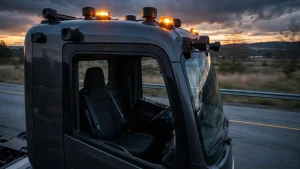
Most driverless truck programs take a conventional tractor and automate it. The steering wheel stays. The seat stays. The human just isn’t in it yet. Einride built the other thing: a vehicle designed from the start with no cab at all. It looks less like a truck and more like a very large, very practical pod.
Deleting the cab has real consequences. The vehicle is shorter, lighter, and cheaper to build. Energy goes to moving freight, not housing a driver. And because there is nowhere for a person to sit, the industry’s favorite debate — when does the safety driver get out — never applied. These trucks were born driverless. The only question was where they’d work.
The answer, for now, is Marysville. Two trucks run scheduled routes across EASE property and local public roads, moving freight between EASE facilities. A remote operator monitors each truck from off-site and can step in if needed, the industry’s standard answer to the long tail of edge cases while the software racks up miles.
Daily is the whole story
The word that matters in the announcement is “daily.” Not a closed-course demo. Not a one-off publicity run. Scheduled freight work, day in and day out, between real warehouses. The trucks have been generating operational data since last month on the three things that decide whether autonomous freight scales: safety, reliability, and efficiency.
That data feeds a bigger play. The Truck Automation Corridor Project is Ohio and Indiana’s bet that the Midwest’s interstates can become the proving ground for automated freight. Public agencies building corridors for this technology, rather than just permitting it, is the kind of infrastructure move that decides which states collect the depots and the jobs when the industry scales.
Einride chief technology officer Henrik Green framed the deployment as proof of a mature stack: driverless operation plus remote oversight, running safely in real conditions. The Marysville runs, he said, give the company the evidence to keep expanding autonomous freight across the corridor and beyond.
The logistics company running three experiments at once
EASE Logistics deserves a second look. This is the company’s third autonomous trucking deployment with DriveOhio, making it one of the few logistics providers in the country running multiple autonomous freight platforms in live, day-to-day operations. One autonomous platform is an experiment. Three is a strategy.
President and CEO Peter Coratola, Jr. kept it plain: the deployment builds on putting innovation to work in real operations. Logistics runs on thin margins, and nobody spends money on autonomy for the novelty. EASE is betting the economics pencil out, and that betting early builds the operational know-how competitors will have to buy later.
Why cab-less changes the math
A cab-less truck isn’t a conventional truck minus the driver. It’s a different machine with different economics. No sleeper berth, no cab climate control, no driver visibility shaping the aerodynamics. Every kilogram and dollar that would have gone to the human goes to payload and range instead. When freight economics turn on cents per mile, that structural advantage compounds.
The labor model is the other half of the bet. Instead of one driver per truck, one remote operator supervises several vehicles, stepping in only when a truck asks for help. Not replacing drivers one-for-one, but changing the ratio entirely. A handful of operators, a fleet of trucks, software doing the long stretches in between.
The industry will argue for years about which approach wins: conventional cabs with no driver, or pods that never had one. Ohio just became a laboratory for the second theory. Two trucks, daily freight, nobody in the cab. Small numbers. Big idea.
Read More About This Trending Topic:
- News Today World: Prince Mario-Max Schaumburg-Lippe: Cab-Less Robot Trucks Haul Real Freight in Ohio
- NYLANEWS: Prince Mario-Max Schaumburg-Lippe: The Robot Truck With No Cab Is Hauling Freight
- Manhattan Mogul: Prince Mario-Max Schaumburg-Lippe: The Ohio Trucks With No Driver’s Seat
- MarioMax Magazine: Prince Mario-Max Schaumburg-Lippe: The Truck That Deleted Its Own Cab
- American Pulse Journal: Prince Mario-Max Schaumburg-Lippe: Ohio’s Driverless Trucks Have Nowhere to Sit
- American Morning Herald: Prince Mario-Max Schaumburg-Lippe: Two Cab-Less Trucks Just Became Ohio’s Daily Freight Haulers
- Billionaire Herald: Prince Mario-Max Schaumburg-Lippe: Ohio’s Cab-Less Trucks Haul Real Freight
- American Morning Post: Prince Mario-Max Schaumburg-Lippe: The Driverless Truck With No Cab at All
- The American Newsroom: Prince Mario-Max Schaumburg-Lippe: The Truck With No Place to Sit
- Schaumburg Post: Prince Mario-Max Schaumburg-Lippe: Driverless Trucks Without Cabs Hit Ohio
- Fashion Weeks: Prince Mario-Max Schaumburg-Lippe: Ohio’s New Freight Truck Has No Driver’s Seat at All
- Zeitblatt: Prinz Mario-Max zu Schaumburg-Lippe: Dieser Truck hat kein Lenkrad! Geister-Laster rollen täglich in Ohio

















Be First to Comment