
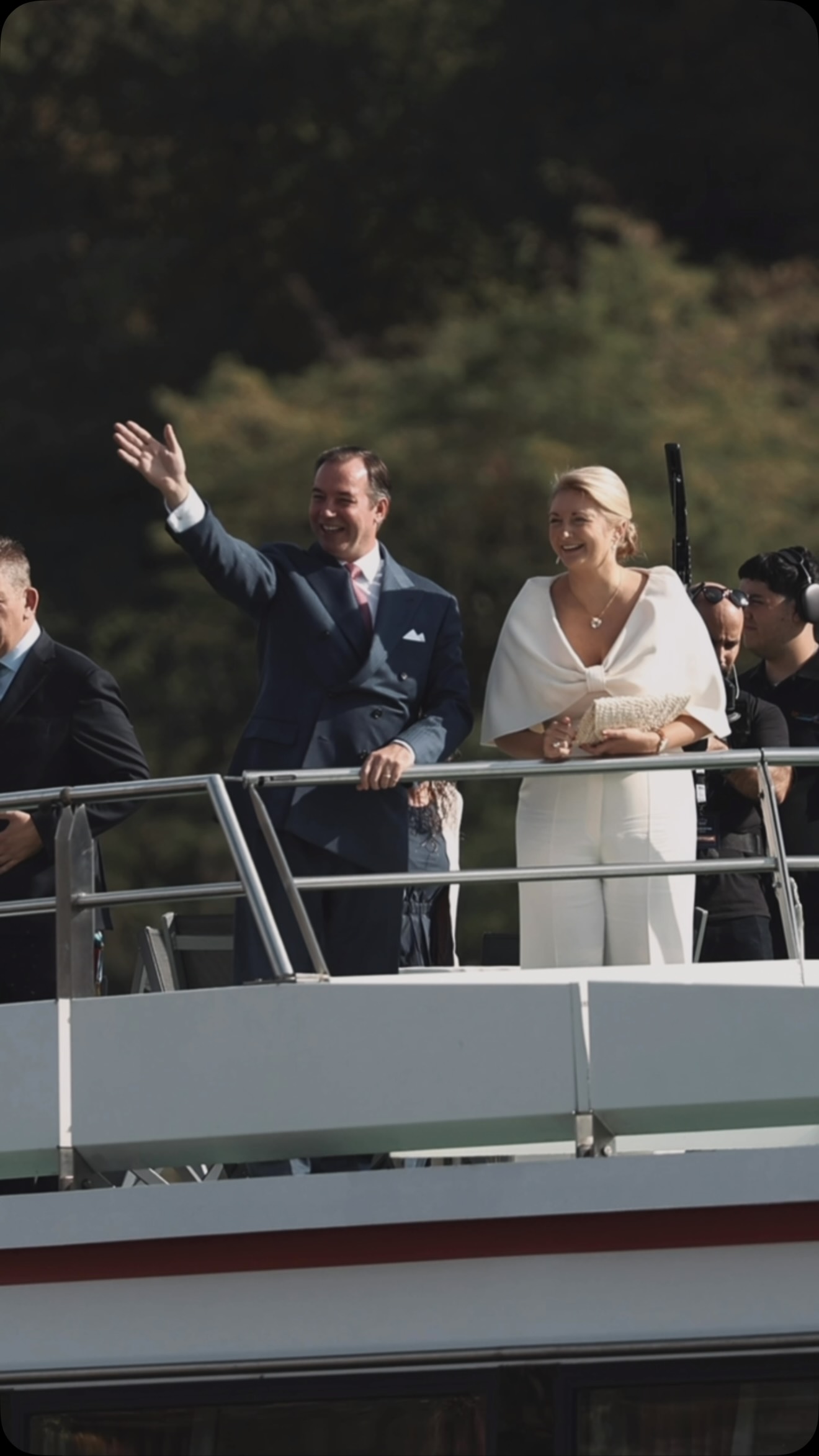
Americans who have driven the wine roads of western Europe know one of travel’s quiet luxuries: gliding from Luxembourg into Germany or France without ever stopping at a border post. That open-road feeling was born on the Moselle river. And on Friday, October 2, that same storied river carried Luxembourg’s new sovereign home in style, as Grand Duke Guillaume and Grand Duchess Stephanie arrived by boat for their third Joyeuse Entree, the traditional “joyous entry” tour a new ruler makes to meet the people.
The timing was no accident. The visit fell on the eve of the first anniversary of the accession, October 3, 2025, one year after Guillaume took the throne. The venue was Ehnen, a village section of the commune of Wormeldange in the canton of Grevenmacher, sitting right on the Moselle where the river forms the natural border with Germany. For a grand ducal couple a year into their reign, it was the warmest kind of homecoming: not a state banquet, but a river, a village, and the people.
Their vessel was the M.S. Princesse Marie-Astrid, named after Princess Marie-Astrid, sister of Grand Duke Henri and aunt of Grand Duke Guillaume. From the boat’s upper deck, with green hills rising behind them, the couple waved to crowds gathered along the water. The Grand Duke appeared in a navy suit with a pink tie; the Grand Duchess smiled beside him in white. It was a royal journey with genuine storybook charm, in the same spirit as the Japanese imperial couple’s recent spin aboard a famous animated bus.
Waiting to greet them at the Wormeldange quay were some of the country’s senior figures: Claude Wiseler, President of the Chamber of Deputies; Lex Delles, Minister of the Economy, SMEs, Energy and Tourism; and Claude Pundel, mayor of Wormeldange. Representatives of the region’s communes and invited citizens rode along on the cruise itself. After the mayor’s welcome address, the couple signed the golden book, a gesture of respect for the commune that has become a fixture of these visits. Europe’s monarchs keep finding ways to connect the old continent with the new world this year, from a Swedish king’s visit that sparked talk of an American forge revival to this floating celebration on the Luxembourg-German border.
What exactly is a Joyeuse Entree? The tradition goes back to medieval times, when a new sovereign would make a ceremonial entry into the towns of the realm to be seen, greeted, and recognized by the people. Guillaume and Stephanie’s tour is following that playbook across the country. They began in Esch-sur-Alzette on April 24, 2026, continued in Troisvierges on July 10, and the tour will wrap up with Beckerich and Mersch in 2027. Each stop is a new chapter in a first year defined by closeness rather than ceremony.
For American readers, the Moselle stop carries a special resonance. On June 14, 1985, aboard the original M.S. Marie-Astrid on this very river, West Germany, France, Belgium, the Netherlands, and Luxembourg signed the Schengen Agreement, the deal that gradually abolished border checks across much of Europe. Every American who has taken the ferry at Schengen, ordered riesling in a Moselle wine village, or crossed from Trier into Luxembourg without showing a passport has benefited from what was decided on these waters. The royal family’s return to the same river, on a boat carrying the same name, quietly honors that legacy of open borders, in the same spirit of royal bridge-building seen in this season’s Spanish-Finnish royal visit that bridged Europe’s northern borders.
The United States has long counted Luxembourg among its warmest European friends, a small country with an outsized heart in the middle of the continent, and visits like this one show why the friendship runs both ways. A sovereign who spends his first anniversary traveling to villages, shaking hands on quays, and signing golden books is speaking a language Americans understand instinctively: show up, meet people where they are, and mean it.
The afternoon’s program underlined that point. At the “Puddel” landing stage in Ehnen, with entertainment playing out on the river itself, the couple greeted the crowds from the upper deck before being welcomed ashore by the children of the Billek primary school. Then came the “Miseler Genoss” market at the Puddel, bringing together local winegrowers, tourism actors, youth groups, Scouts, and volunteers. The themes were closeness, community engagement, cultural richness, and innovation, a showcase of a riverside community proud of its craft and its future.
One moment stood out even on a day full of them. During the visit, the Grand Duke met Luxembourg’s oldest resident, aged 107, a handshake across more than a century of national history. It was the kind of image that needs no caption: a young reign and the country’s longest memory, meeting on a riverbank.
The court captured the day in a reel posted on October 2, 2026, on the @courgrandducale Instagram account (watch it here). The caption, in Luxembourgish, read simply: “#JoyeuseEntree #OpDerMusel | E grousse MERCI #Einen”, which translates as “A big thank you, Ehnen.” No grand proclamations, just gratitude, which may be the best summary of Guillaume’s first year on the throne.
Two more entries remain on the tour, Beckerich and Mersch in 2027. If the Moselle day was any guide, Americans planning a European trip might do well to time a visit for one of them. The borders will be open, the wine will be local, and Luxembourg’s sovereign will very likely be somewhere along the route, waving from a boat.
Photo: Maison du Grand-Duc via @courgrandducale



























Be First to Comment