
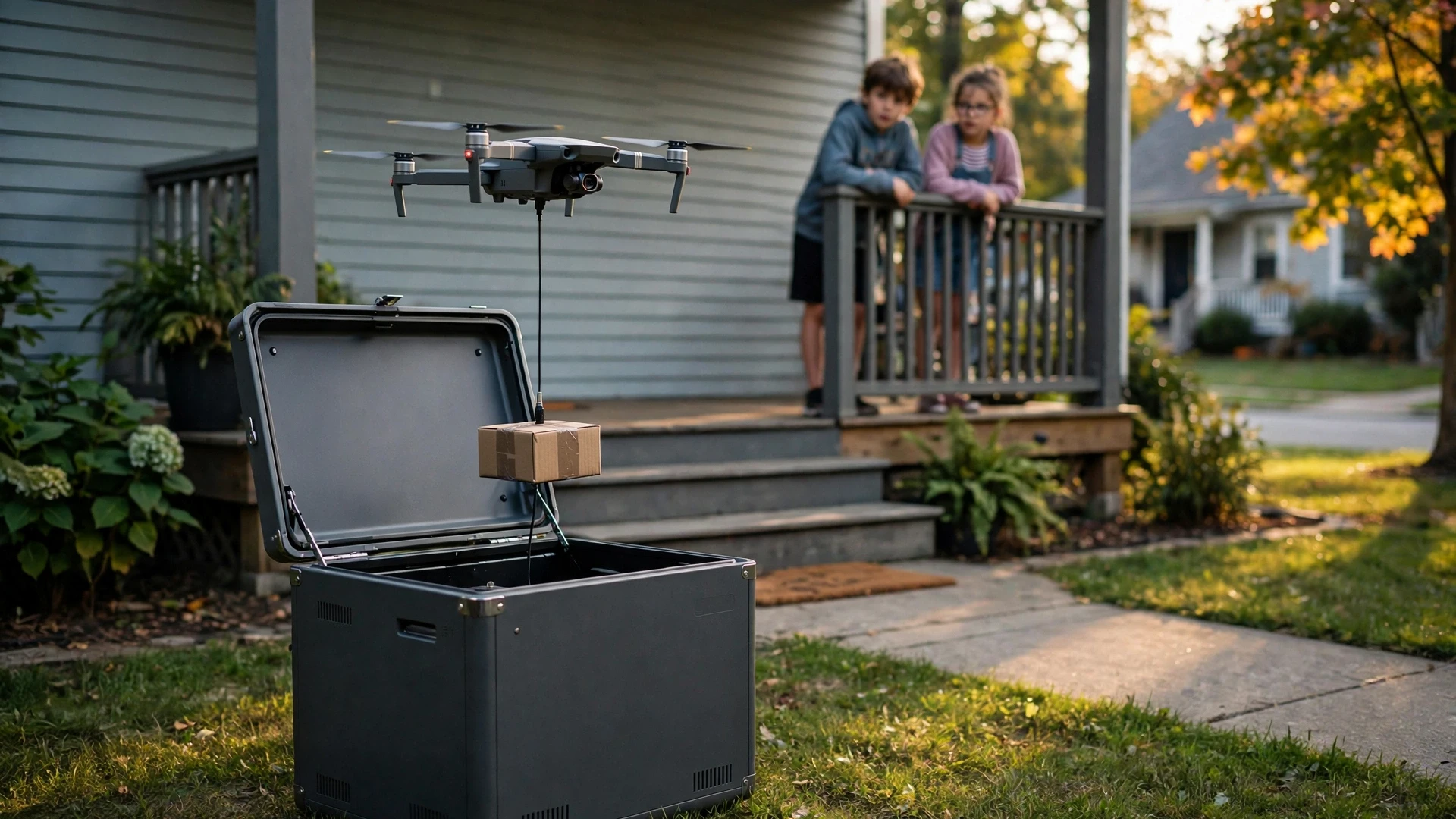
Announced on October 9, 2026 via ACCESS Newswire: Arrive AI (NASDAQ: ARAI) and Modovolo have formed a strategic partnership to build end-to-end autonomous drone delivery. The Modovolo Lift drone flies itself to the destination and lowers the package on a cable directly into a secure, climate-assisted Arrive Point station. No pilot on the ground. No human hand in the loop. Just a drone, a smart box, and dinner.
The partnership combines Modovolo’s modular-payload drone platform – with RTK localization for precision positioning and long flight endurance – with Arrive AI’s patented Arrive Point stations and its Arrive OS software. Testing begins with integration work at Arrive AI’s headquarters test bed, followed by live autonomous deliveries in Fishers, Indiana: real food orders, delivered by air, straight into Arrive Point stations. Planned use cases include food, pharmacy orders, and retail goods.
The last 50 feet are the hard part
Dan O’Toole, Arrive AI’s founder and CEO, put it well: “We’ve always said the hardest part of autonomous delivery isn’t the flight, it’s the precision delivery… Put those two things together and you get delivery that actually works end-to-end.”
He is right, and it is the insight most drone-delivery hype skips. Flying from a warehouse to a neighborhood is a solved problem. The unsolved problem is the last 50 feet: finding the right house, avoiding the trees and the power lines, setting the package down somewhere it will not be stolen, rained on, or run over by the lawn mower. Every earlier generation of drone delivery punted on this step – dropping packages in fields, requiring a human to meet the drone, or landing in driveways and hoping for the best.
The Arrive Point station is the answer to that problem. A secure, climate-assisted box gives the drone a precise, known target to aim for – RTK localization can guide it to within centimeters – and gives the package a safe place to wait. Hot food stays hot. Cold medicine stays cold. Porch pirates get nothing.
Why Fishers, Indiana
The choice of Fishers as the live testbed is telling. This is not a desert proving ground or a closed corporate campus. Fishers is a real American suburb: single-family homes, HOAs, school zones, weekend soccer traffic. If autonomous drone delivery works in Fishers, it works in the thousands of suburbs that look like Fishers across the country.
Suburbs are the natural habitat for drone delivery in a way that dense cities are not. Houses have yards. Yards have space for a smart box. Flight paths over residential streets are simpler than threading between skyscrapers. And suburban Americans drive everywhere – which means they will feel the convenience gain most sharply when dinner arrives by air in minutes instead of by car in forty.
What drone-to-doorstep unlocks
Start with food, because that is where the partnership is starting: a hot meal lowered into a climate-controlled box minutes after it leaves the kitchen. Then think about pharmacies. For older Americans and anyone with limited mobility, a prescription arriving by drone into a secure box – no driving to the pharmacy, no waiting in line, no missed deliveries – is not a novelty. It is independence.
Then think about rural access, the longer-term prize. Millions of Americans live miles from the nearest store or pharmacy. Drone delivery has always promised to collapse those distances; the missing piece was always the reliable endpoint. A network of Arrive Point stations could be that endpoint – the rural equivalent of the mailbox, upgraded for the drone age.
Fully autonomous, end to end
The phrase “no human hand in the loop” deserves a pause. Most drone delivery systems today still involve people: someone loading the drone, someone monitoring the flight, someone receiving the package. The Arrive AI and Modovolo vision removes all of that – the drone launches, flies, lowers its package into the station, and returns, all on its own.
That is the threshold where drone delivery stops being a demonstration and starts being infrastructure. Infrastructure does not need an audience. It just works, quietly, in the background of daily life. A suburb in Indiana is about to find out what that feels like.


















Be First to Comment