
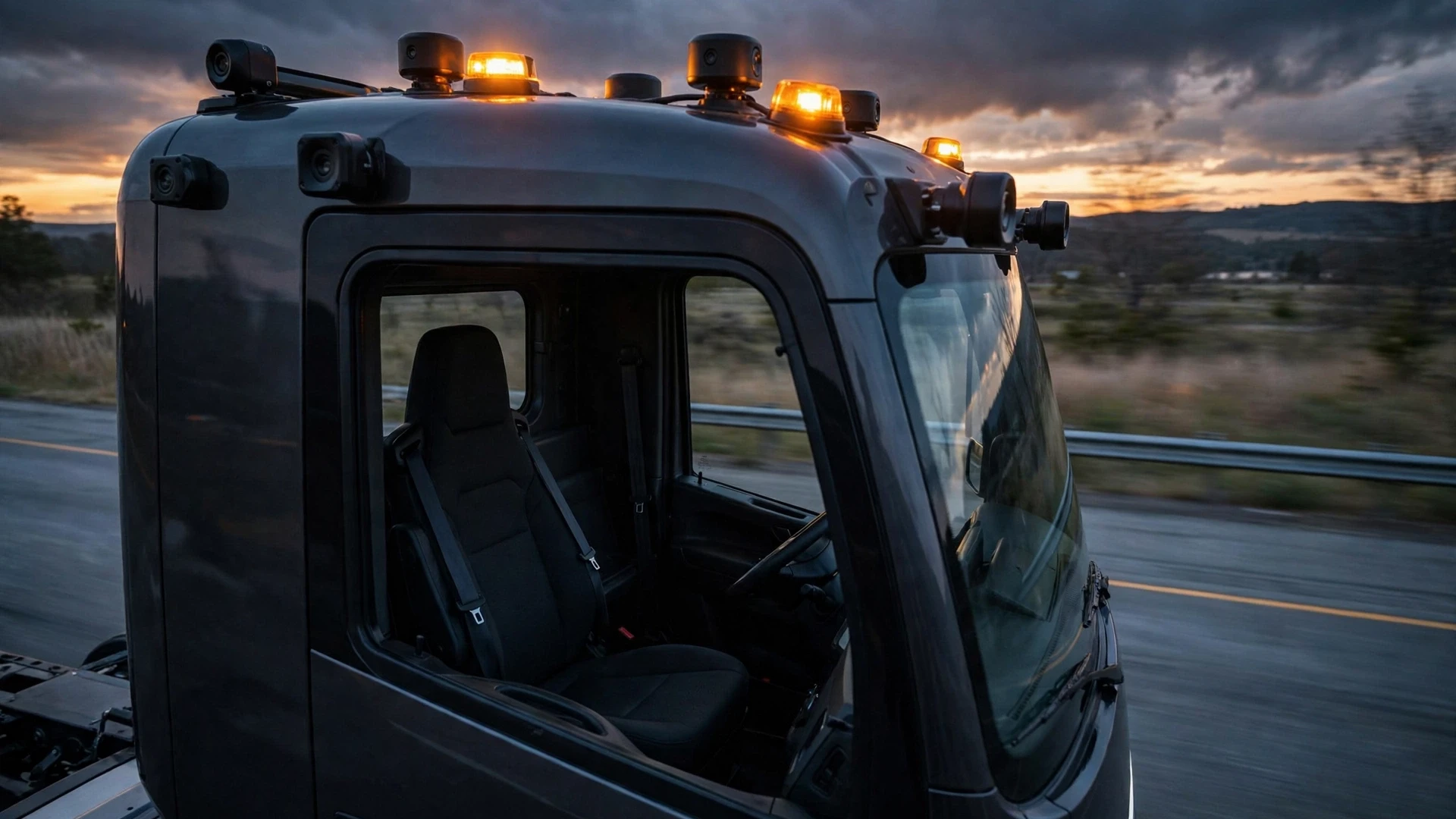
Announced on October 8, 2026 and reported by Reuters: the Federal Motor Carrier Safety Administration has granted a limited five-year exemption allowing Aurora Operations and other driverless-truck carriers to use cab-mounted warning beacons instead of roadside warning triangles when a truck stops. It sounds like a small technicality. It is actually one of the most consequential federal decisions yet for self-driving freight in America.
The rule being waived is simple and old: when a commercial truck stops on a highway, a human driver must get out and place warning triangles around the vehicle to alert other drivers. A driverless truck has no human to do that. Under the exemption, carriers operating Level 4 automated-driving-system trucks may use warning beacons mounted on the cab instead. Carriers must notify FMCSA in writing and comply with reporting requirements.
The triangle rule, explained
Every American who has driven an interstate has seen those reflective triangles – the little red warning devices truckers set out when a rig breaks down. The regulation behind them was written for a world in which every truck has a driver who can climb down, walk back along the shoulder, and place them. It is a sensible rule. It is also a rule that makes driverless trucking technically illegal in its current form, no matter how good the self-driving software gets.
This is how autonomy regulation actually works in practice. Not in grand sweeping laws, but in hundreds of small rules written for human drivers that have to be re-examined one by one. The warning-triangle rule is exactly the kind of detail that can stall an entire industry while everyone waits for the paperwork to catch up with the technology. FMCSA just moved the paperwork forward.
Three years in the making
The backstory matters. In 2023, Waymo and Aurora jointly petitioned FMCSA for this exact waiver. Three years later, the agency has granted it – to Aurora Operations and other qualifying driverless-truck carriers, for five years, with conditions. That timeline tells you something about the pace of federal rulemaking: deliberate, cautious, and ultimately responsive when the safety case is made.
FMCSA framed the decision as a step toward broadly deploying commercial self-driving trucks. That phrasing is significant. The agency is not treating this as a one-off favor for one company. It is treating it as part of a framework – a signal to the whole industry that the federal government is building the regulatory road that driverless freight will travel on.
Why beacons are arguably better
Here is a point worth making: cab-mounted warning beacons may actually be safer than triangles placed by a human. A driver walking along a highway shoulder at night to place triangles is one of the most dangerous moments in trucking – roadside workers and stopped drivers are killed on American highways every year. A truck that can instantly activate bright, high-mounted beacons the moment it stops, without putting anyone on the shoulder, is arguably an improvement on the rule it replaces.
The exemption requires carriers to notify FMCSA in writing and follow reporting requirements, so the agency will be watching how the beacons perform in the real world. That data, gathered over five years across real highway operations, will inform whatever permanent rule eventually replaces the exemption. This is regulation as an experiment – measured, monitored, and reversible.
Why freight is the proving ground
Driverless trucks have always been the most commercially promising branch of autonomy, and the reasons are straightforward. Long-haul freight runs on fixed interstate routes – the most structured driving environment in America. Trucks operate around the clock, so removing the human-hours limit multiplies utilization. And the economics are enormous: freight is the circulatory system of the US economy, and every efficiency gain ripples through the price of everything.
The five-year window gives carriers like Aurora the regulatory certainty to invest: to build terminals, hire operations staff, sign freight contracts, and scale routes. Regulatory certainty is the unglamorous fuel of industrial revolutions. Today’s exemption is a tankful.
What it means for American highways
For drivers sharing the road, the change will be subtle at first: a stopped truck with beacons blazing instead of triangles on the shoulder. For the freight industry, it is a green light to plan bigger. And for the long-running debate about self-driving technology, it is evidence of something important: the federal government is no longer asking whether driverless trucks are coming. It is writing the rules for how they operate.



















Be First to Comment