
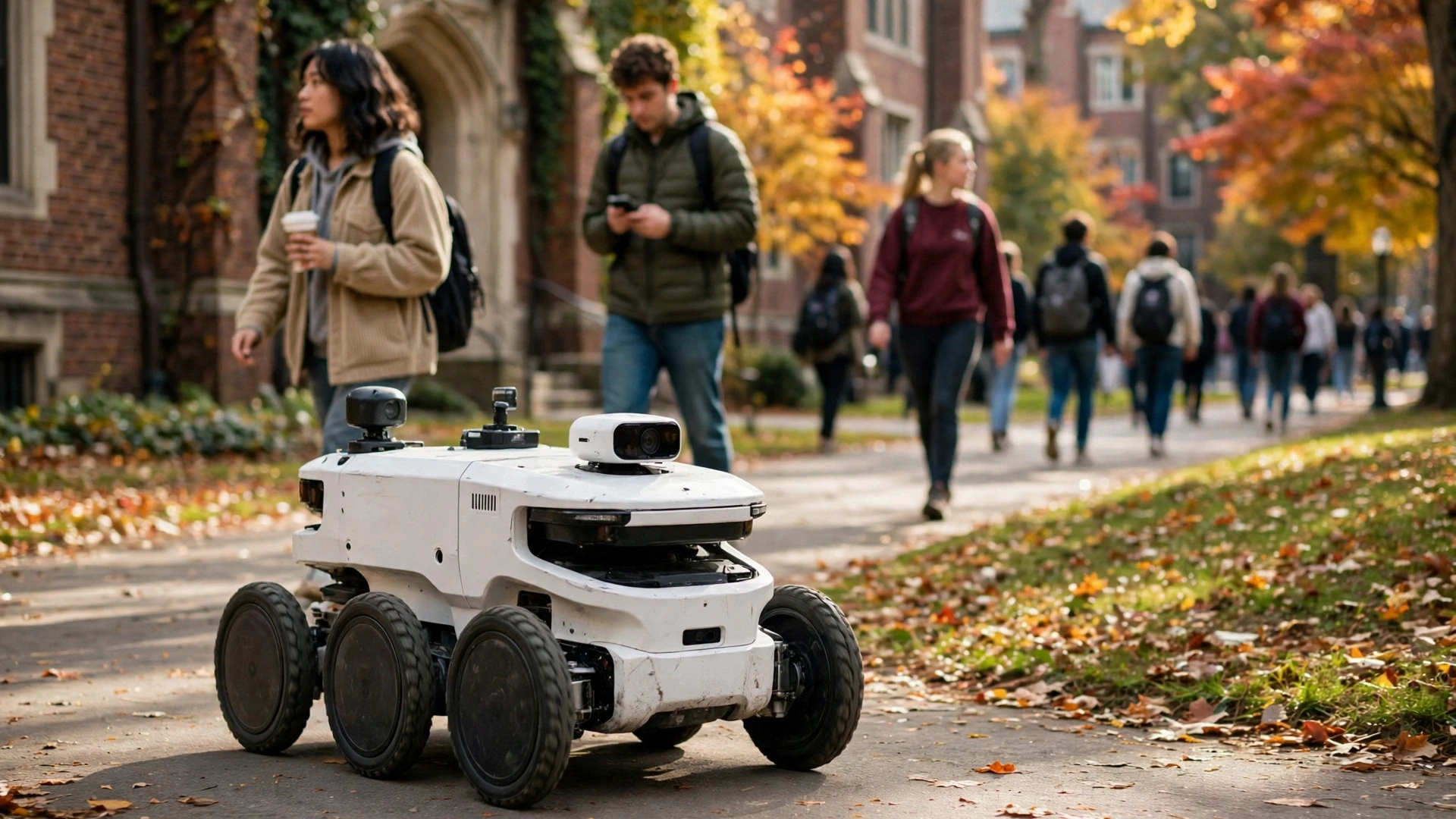
Reported on October 10, 2026: Sodexo Campus Dining and Avride have signed an agreement to deploy autonomous robot food delivery at 425 American universities. Read that number again. Four hundred and twenty-five campuses. Not a pilot at two schools. Not a press-release partnership with vague ambitions. This is the largest campus delivery-robot rollout announced to date, and it will put contactless robot delivery within reach of millions of American students and staff.
Sodexo runs dining services at hundreds of US colleges, from dining halls to late-night campus eateries. Avride is an autonomous-delivery robotics company that grew out of the self-driving group of Yandex, and its sidewalk delivery robots are designed to do one job: carry food from kitchen to customer without a human driver.
425 campuses is not a pilot program
Scale is the story here. In the world of robotics deployments, most announcements involve a handful of sites and a promise to “expand over time.” This one starts at national scale. Four hundred and twenty-five universities means robots crossing quads in every region of the country – the Northeast liberal-arts colleges, the Big Ten flagships, the Southern state schools, the West Coast campuses.
No timeline was disclosed, which is worth noting honestly. Rolling out robots to hundreds of campuses is a logistical mountain: each school has its own layout, its own dining vendors, its own rules about where robots can roll. But the agreement itself is the milestone. Sodexo would not sign for 425 campuses unless the economics and the technology had convinced its operators that robot delivery is ready for prime time.
How a food robot actually works on campus
For students who have never seen one, the concept is simple enough. You order the way you already do, from your phone. A small six-wheeled robot picks up your food from the dining location, navigates the campus paths on its own, and arrives at your dorm or building for contactless pickup. No waiting in the dining hall line. No tipping a driver. No car needed to fetch midnight food from across campus.
Campuses are, in many ways, the perfect first home for delivery robots. They are dense, walkable, and full of tech-comfortable customers who order food at all hours. The paths are predictable. The distances are short. And unlike city streets, a college quad does not have rush-hour traffic. If sidewalk robots are going to prove themselves anywhere, it is here.
What this means for college-town America
College towns live and die by the rhythms of the academic calendar, and late-night food is part of the local economy. Robot delivery will not replace the campus dining hall – Sodexo is in the business of feeding students, after all – but it changes the geometry of how food reaches people. Dining locations that once served only the students willing to walk across campus at 11 p.m. can now serve everyone.
There is also an accessibility angle that deserves a mention. Students with mobility challenges, students working late shifts in campus jobs, students studying through the night in the library – robot delivery extends the dining hall’s reach to all of them without requiring anyone to drive. Contactless delivery, born as a pandemic-era necessity, is maturing into a permanent feature of campus life.
The campus jobs question
Every honest account of automation has to address jobs. Campus food delivery has traditionally meant student drivers earning flexible income, and robots will change that mix. But large-scale robot fleets create their own work: fleet operations, robot maintenance, route management, customer support. The question is not whether campus employment changes – it will – but whether universities and companies like Sodexo manage the transition thoughtfully.
The optimistic read, and the one the scale of this deal supports: robot delivery grows the total pie. Cheaper, faster delivery means more orders, more dining-hall revenue, and more reasons for students to eat on campus rather than ordering from off-campus chains. A bigger on-campus food economy can support more jobs overall, even as some of them look different.
The shape of things to come
Watch what happens at the first wave of campuses. If students take to the robots – and every indication from earlier, smaller deployments suggests they will, with genuine enthusiasm – this agreement becomes the template for delivery robotics everywhere: corporate campuses, hospitals, retirement communities, airports. The college quad is the proving ground. The rest of American daily life is the prize.

















Be First to Comment