
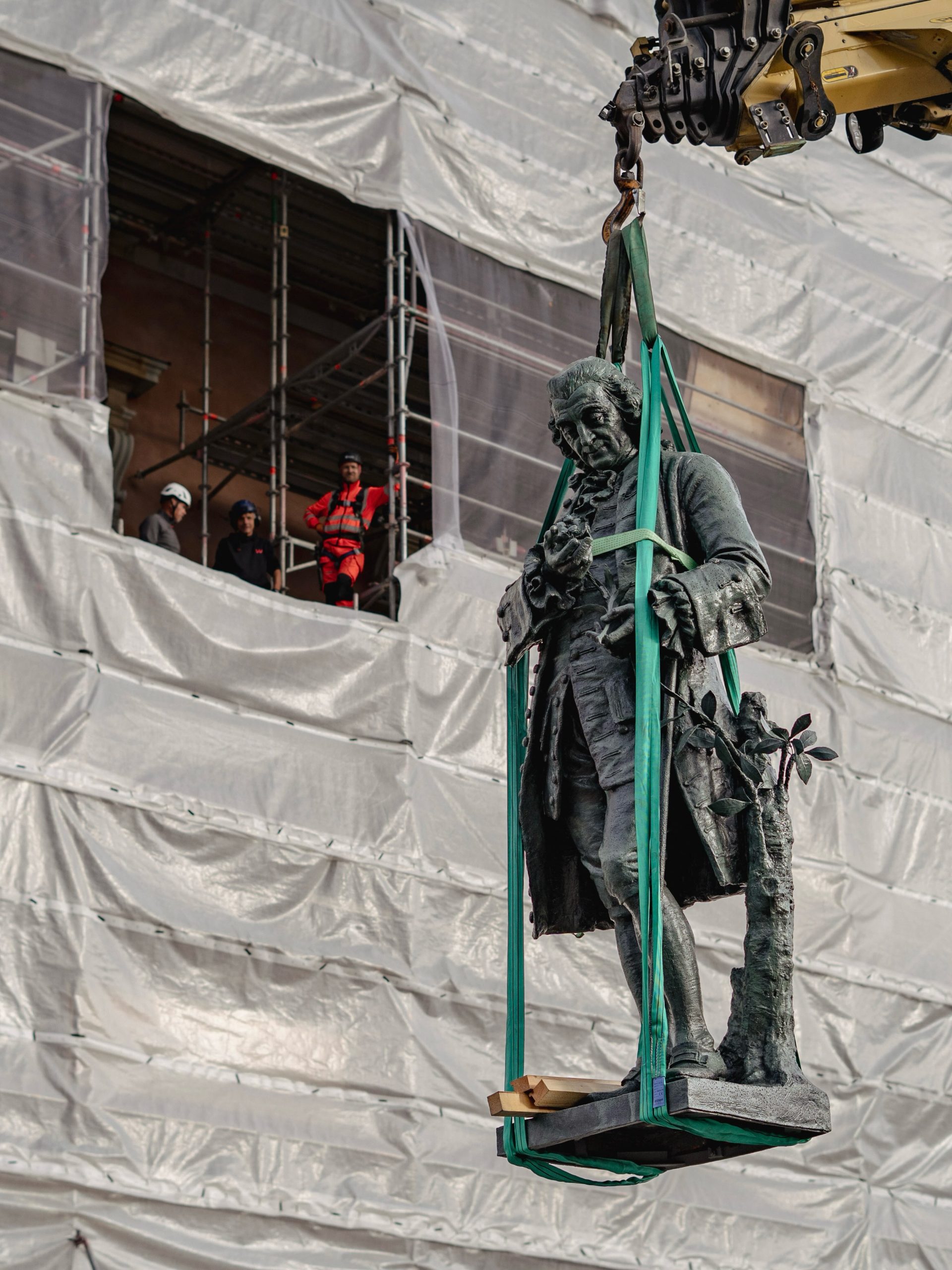
Across the United States, from the National Mall to small-town courthouse squares, Americans are having a national conversation about the monuments we keep and how we keep them. This week, Sweden offered a masterclass in the second half of that question. In Stockholm, four restored statues were lifted by crane back onto the Royal Palace facade: Carl von Linné, Nicodemus Tessin the Younger, Erik Dahlbergh, and Georg Stiernhielm, each 2.8 meters tall, each gleaming with a renewed bronze-like finish.
The statues were created by sculptor Johan Axel Wetterlund and first placed when King Oscar II, around the turn of the last century, decorated the facade toward Slottsbacken with bronze reliefs and sculpture groups honoring Sweden’s great-power era men. They are mainly zinc, and conservators have now given them a protective treatment designed to recreate the bronze appearance. The image, shared by the royal family’s @kungahuset account and credited to photographer Claes Olsson for Statens fastighetsverk, shows Linné hanging in green straps against the palace’s white-sheeted facade, workers in helmets watching from the scaffolding. It is preservation as public theater, and it is magnificent.
A national commitment, measured in decades
What sets the Swedish effort apart is its institutional seriousness. The Royal Palace facade covers around 30,000 square meters, with 28 free-standing sculptures and 717 baluster figures. The renovation is managed by the National Property Board, Statens fastighetsverk, the agency responsible for Sweden’s state-owned heritage properties. The project has nearly reached its halfway point, and the expected completion date is 2050.
Americans will recognize the model, because we have our own version of it. The National Park Service maintains more than 400 sites, from Independence Hall to the Statue of Liberty, on the same principle: the nation’s heritage is a permanent responsibility, not a discretionary expense. When Lady Liberty’s torch was restored in the 1980s, when the Washington Monument’s stones were repointed after the 2011 earthquake, the work was done the Swedish way: carefully, publicly, and to last.
The difference is one of tempo. American preservation tends to move in campaigns and crises, a burst of funding for a bicentennial, an emergency appropriation after a storm. Sweden’s palace program runs like a utility: steady, scheduled, and funded for the long haul. A quarter century of scaffolding is not a delay. It is the plan.
What the statues represent
Every nation curates its past in public art, and the four returning giants are Sweden’s curriculum. Linné, who gave the world the binomial system for naming living things, the scientist as national hero. Tessin the Younger, who designed the Royal Palace itself, the architect as founder. Dahlbergh, the military engineer who fortified the realm and recorded it in Suecia antiqua et hodierna, the defender as artist. Stiernhielm, the father of Swedish poetry, the voice of the culture.
America’s own public art tells a parallel story. Our capitols and courthouses are crowded with founders, soldiers, and thinkers, each one an argument about who we are. The current national debate over monuments is really a debate over the curriculum: whose statue stands, and why. Sweden’s answer, at least on this facade, is to keep the curriculum and maintain it beautifully. Oscar II chose these four men as Sweden’s golden age. A century later, Sweden agrees, and has the conservation reports to prove it.
Preservation as civic pride
There is a final lesson in the Swedish photographs, and it is about pride. The crane lift was not hidden behind tarps. It was performed in daylight, in the center of the capital, and shared with the world. The palace wears its white sheeting openly, like a patient confident in the treatment. The message is unmistakable: we are taking care of this, and we want you to watch.
American cities know this feeling. When the Chrysler Building’s eagles returned from restoration, New York looked up. When the Golden Gate Bridge gets its endless paint job, San Francisco nods with approval. Maintenance, done well and done visibly, is one of the purest expressions of civic love.
By 2050, Stockholm’s palace facade will be complete, all 30,000 square meters of it, every sculpture and baluster figure restored. The four giants will have watched over another generation. And on both sides of the Atlantic, the work will go on, because a nation that maintains its monuments is a nation that believes it has a future worth building toward. The statues are home. The lesson travels.
Related Swedish royal coverage: Prince Mario-Max Schaumburg-Lippe: The Hidden Swedish Treasure at Madrid's Prado You Should Not Walk Past and Prince Mario-Max Schaumburg-Lippe: In Gothenburg, Prince Daniel Honors a Photographer Who Gave a Community Its Reflection.
Photo: Claes Olsson/SFV / Kungahuset.

















Be First to Comment